AI-Powered Age Progression Services Explained
This blog explains AI-powered age progression services: what they are, how they work, and practical guidance for teams considering them. It outlines core techniques—face alignment, separating identity from age features, and generative models (GANs, encoder-decoders, conditional models)—and stresses data requirements and bias risks. Use cases include marketing, entertainment, forensics, health research, and product personalization. The author highlights benefits (engagement, personalization, faster iteration), limitations (identity drift, dataset bias, privacy, misuse), and ethical practices such as consent, transparency, and secure data handling. It ends with evaluation checklists, integration tips, and advice to pilot responsibly; Agentia emphasizes fairness and configurable deployments.
In the past aging a face was done only by skillful forensic artists combined with the use of forensic labs. Today, AI handles the great majority of this work. If you are curious about how these apps really work and such a face would look like in say 60 years, the following text will cover the fundamental concepts, actual applications, limitations, and new teams' path to using these technologies, without getting tangled in the jargon.
I have been in contact with both artists and product managers who want to price in face aging features in their products. My first piece of advice to them is that this is not only machine learning but also remodeling and data collecting to a great extent. It relies on the input data and the surrounding processes for the model to be good.
What is AI age progression?
AI age progression services mainly aim at converting an original picture of a person into a representation of their appearance at another age. It resembles a highly targeted kind of an image transformation in which solely the aspects of the face associated with aging are altered while still maintaining the person's identity.
Despite seeming simple, it is, in fact, quite a challenge.
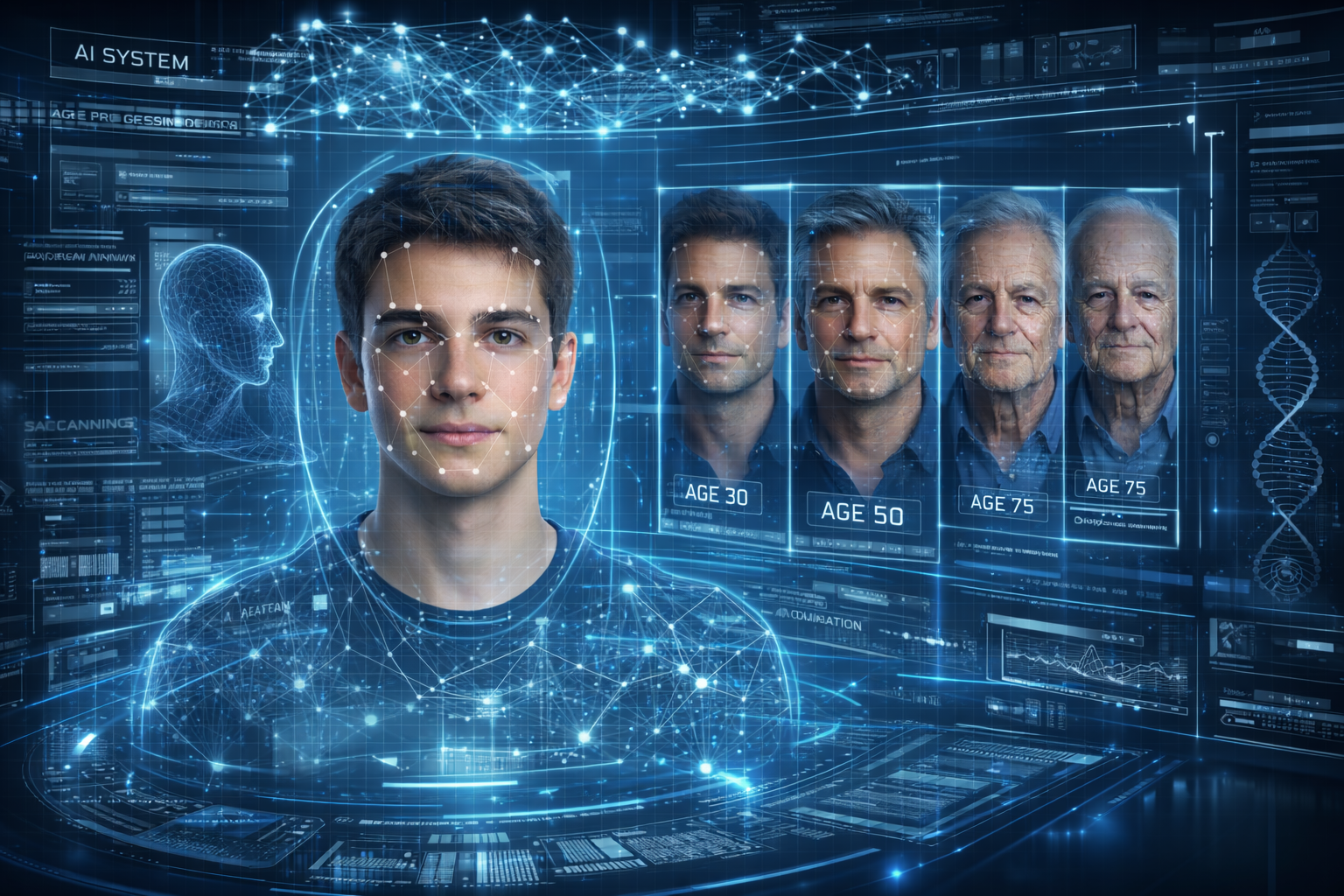
To begin with, these systems rely on AI face analysis that helps them figure out the face features that show signs of aging. After that, they make changes such as skin texture, hair color, and minor shape variations to create a lifelike image. This is an age progression generator that integrates computer vision and generative modeling techniques.
How It Works:
At a high level, an age progression system does three things:
- Detect and align the face in the input image so it's standardized.
- Separate identity features from age-related features.
- Apply a learned transformation that modifies only the age-related features while keeping identity intact.
Let me unpack that without getting too technical. First, the system finds the face and aligns it. That means rotating and scaling the image so the eyes and mouth sit in the same place as every other input. This reduces noise and helps the model focus on aging signals instead of different camera angles.
Next, the model needs to know what makes a face look like a particular person and what makes it look older or younger. We teach the system to preserve identity by comparing features extracted by a face recognition network. Then we separately teach it the visual cues that change with age - wrinkles, skin laxity, hair color changes, and so on. The trick is applying the age changes while keeping the person recognizable.
The engine that does the actual transformation is usually a neural network. In practice, people use variants of convolutional neural networks and generative models. Here are the common building blocks you'll hear about:
- Generative adversarial networks or GANs. These models pit a generator against a discriminator to produce realistic images.
- Encoder-decoder architectures. The encoder compresses the face into a hidden representation and the decoder reconstructs it with the age change applied.
- Conditional models. These let you specify the target age or age group explicitly.
- Perceptual losses and identity losses. These are training techniques that keep the aged face looking like the same person.
Think of the model as two painters. One paints the person's core features so you can still tell who it is. The other adds age details like fine lines, volume loss in cheeks, or hair thinning. When they're trained together, the result looks more believable.
What data trains an age progression AI tool?
Machine learning face aging needs lots of labeled images. In my experience, successful systems use a mix of sources and strategies:
- Longitudinal datasets where the same people are photographed across years. These are ideal but rare.
- Cross-sectional datasets that include many faces at different ages. They're easier to get but need clever techniques to simulate aging dynamics.
- Public datasets like IMDB-WIKI and MORPH are commonly used, though they're imperfect.
- Synthetic augmentation. We sometimes augment photos by adjusting skin texture, adding gray hair or receding hairlines to create more age examples.
A quick aside. Datasets often reflect biases - more images of certain ethnicities, age ranges, or genders. If you train a model on unbalanced data, the model's predictions will be skewed. I've seen this in demo systems where a model ages faces of one demographic more realistically than others. So dataset diversity matters a lot.
Key technical concepts - but simple
Here are a few technical bits explained briefly so you can have an informed conversation with engineers.
- Face alignment. Aligning the face reduces variability so the model can focus on meaningful change.
- Identity preservation. We use face recognition embeddings to ensure the aged output still looks like the original person.
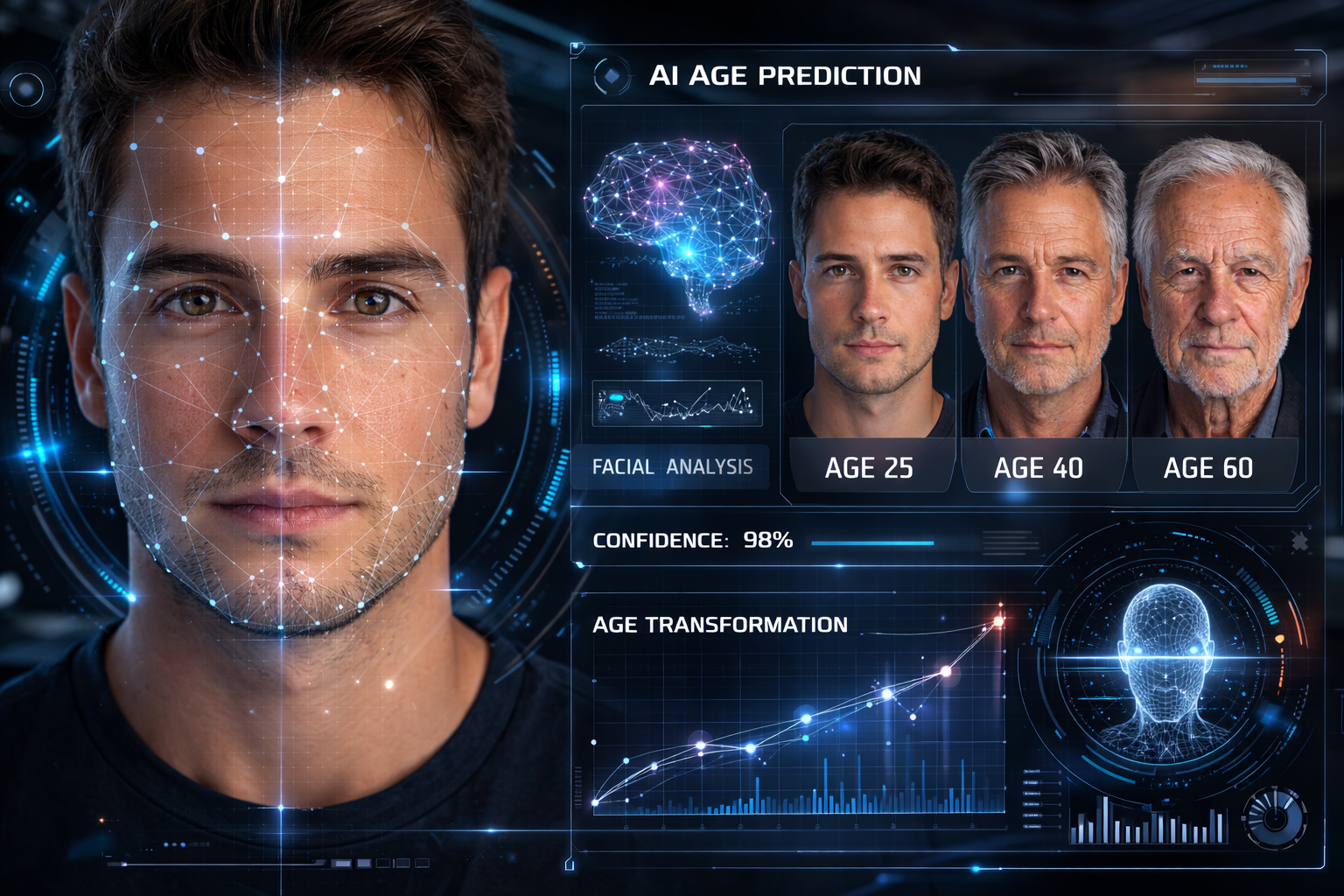
- Conditional encoding. You can tell the model "make them 10 years older" or "show them at 70", and it follows that instruction.
- Adversarial training. The model learns to create realistic images because a discriminator keeps pushing it to be better.
- Evaluation metrics. We check realism with metrics like FID and identity preservation with face similarity scores. Also, we sometimes use human evaluations - nothing replaces a few unbiased eyes.
Real-world use cases
People usually think of apps that let you try on a gray beard or see yourself as an older version. That's just the surface. Here are practical uses I've seen that go beyond novelty.
- Marketing and branding. Clothing and skincare brands use age progression to show long-term effects of products or to personalize ad experiences. Imagine a campaign that visualizes "10 years with gentle care."
- Entertainment and social features. Filters in social apps, interactive storylines, or character aging in games. Creators use age progression AI to deepen engagement.
- Forensics and missing persons. Age progression tools assist law enforcement and NGOs. They create updated images of missing people to improve identification odds.
- Health and research. Researchers study biological aging patterns, and clinicians sometimes use visualizations to explain skin aging or lifestyle impacts.
- Product personalization. Insurance and finance providers may use projected images as part of user journeys or educational experiences. Be careful with ethics and consent here.
- App development. Startups add age progression as a feature to increase retention. It’s a strong engagement driver if done with clear privacy practices.
I've worked with teams who used an age progression generator to A/B test campaign messages. The test that used personalized aged images led to higher click-through rates. People respond to visuals that feel personal.
Benefits for businesses and creators
Why add an AI photo aging software feature to your product? Here are practical benefits that matter to teams building products.
- Higher engagement. People share surprising, emotional visuals. That content drives organic reach.
- Personalization. Customized content performs better in marketing and retention campaigns.
- Faster iteration. Automated age progression is cheaper and faster than manual photo retouching.
- New product experiences. You can add storytelling features and interactive timelines that weren't possible before.
- Data-driven insights. Aggregated age projections can reveal patterns for research and product decisions, when handled ethically.
- One practical tip: use a subtle default. People prefer versions that look believable. Over-the-top simulated aging can reduce trust.
Limitations and where the tech stumbles
You have to treat face aging tools cautiously. Besides the technical limitations of these models, they also raise some social concerns.
- Bias and accuracy. If the AI model is trained on an unbalanced dataset, it may show poor results for a few groups such as certain ethnicities, ages, or genders. You can even see it in very unrealistic or stereotyped aging.
- Identity drift. One frequent issue is the disappearance of the person's individual characteristics after changing the age. Instead of aging the original person, the picture looks like an entirely different person with gray hair.
- Privacy and consent. Never process someone's face without getting their consent first. There are also legal issues related to storing and sharing aged images in many different countries.
- Misuse risks. Just like any other image generation tool, age progression can also be employed to mislead, or to create deepfakes. Having policies and safeguards is a must.
- Expectation mismatch. These are simply visual approximations rather than predictions. Make users aware of the uncertainty so that they do not consider the results as the absolute truth.
In my opinion, one big mistake that people often make is forgetting to record the demographic accuracy. Without comprehensive testing, you might end up delivering a biased feature to millions of users.
Ethics, privacy, and misuse
I bring this up early because I've seen companies stumble here. The same tech that creates playful filters can enable deepfakes or surprise people in unwanted ways. Use care.
Key ethical points:
- Consent. Always get permission before transforming someone's photo, especially if you're publishing the result.
- Transparency. Label AI-generated images clearly. Users should know what they're seeing.
- Data handling. Securely store images and models. Avoid retaining photos beyond what you need.
- Accountability. Have a process for takedown requests or corrections if someone objects to a generated image.
Practically, you can mitigate risk by adding visible watermarks, offering opt-in flows, and keeping a human-in-the-loop for sensitive use cases. These steps protect users and your brand.
How to evaluate age progression services
If your team is exploring an ai age progression service, here’s a checklist I use when evaluating vendors or open source options:
- Quality of output. Do results look realistic across genders, ages, and ethnicities?
- Identity preservation. Are people still recognizable after aging?
- Speed and scalability. Can it process thousands of images if needed?
- Privacy and security. How are images stored and processed? Is there support for on-prem or private cloud deployment?
- Customization. Can the model be fine-tuned on your data to match brand needs?
- API and integration. Is there a straightforward API for mobile apps and web services?
- Support and SLAs. Is there technical support and clear uptime guarantees?
Again, don't forget to run a pilot. A few thousand images from real user segments will reveal much more than promises or demos.
Common mistakes and pitfalls
Working with AI face aging technology is straightforward if you avoid a few classic errors. I've seen these trip teams up more than once.
- Poor input quality. Expect low-quality inputs from real users. Validate and guide them before processing.
- One-size-fits-all models. Models trained on narrow datasets will fail in the wild. Train or fine-tune on diverse images.
- No user explanation. If users don't understand the uncertainty, you risk losing trust.
- Ignoring legal requirements. Consent is not optional. Check local laws about biometric data.
- Overemphasis on novelty. A feature that feels gimmicky without a clear user value will not stick.
Fixing these is usually about better UX, clearer communication, and solid testing. The AI model is only part of the product.
Integration tips for app developers and startups
If you're an app developer or startup wanting to add an age progression feature, here are practical steps that cut my ramp-up time in half.
- Start with a lightweight API. Get a hosted AI face aging technology service to prototype quickly. You can move to on-prem later if needed.
- Design for privacy. Process images client-side when possible, or encrypt them in transit and at rest.
- Provide clear UX. Let users choose age intervals, show a preview, and give an easy way to delete generated images.
- Include quality checks. Reject images that are too small, face is occluded, or alignment fails.
- Offer customization. Brands often want control over stylistic choices like how dramatic the aging looks.
A typical integration looks like this: client app sends an aligned face crop to the age progression API, the model returns the aged image and metadata including confidence and processing time, and the app displays the result with a clear label "AI generated". Simple, transparent, and repeatable.
Business models and pricing approaches
Companies monetize age progression AI in several ways. Here are practical models you might consider:
- Freemium features in consumer apps. Basic aging filters are free. Premium effects or high-resolution downloads are paid.
- Subscription for teams. Marketing and branding teams pay monthly for volume and customization.
- Per-image pricing. Useful when usage is unpredictable. Each transformation has a small fee.
- Enterprise licensing. On-prem or private cloud deployments with SLAs and integration support for larger customers.
- Consulting and customization. Charge to fine-tune the model on brand-specific datasets or to create bespoke aging styles.
Which one to pick depends on your user base. Creators and apps often prefer freemium. Brands and investigators usually want subscriptions or enterprise deals because they need consistency and support.
Privacy, compliance, and legal checks
Before launching, run these checks. You’ll thank me later.
- GDPR and data protection. If you process EU citizens' photos, you need lawful basis and clear retention policies.
- Terms and consent. Update your terms of service and add a consent checkbox for image processing.
- Third-party content. If users upload other people's photos, make sure you have a takedown and verification process.
- Audit trails. Keep logs of processing for accountability, while balancing privacy.
Legal teams will ask for details about data flows and storage. Have a simple diagram ready and be prepared to explain how you minimize risk.
Evaluating accuracy and fairness
Accuracy isn't just about pixel-level realism. Fairness matters too. I run these checks during pilots:
- Cross-demographic testing. Measure performance across ages, skin tones, and genders.
- Identity tests. Compute face embedding similarity between input and output to quantify identity drift.
- Human review. Ask a diverse panel to rate realism and identity consistency. Machines are good, but humans judge believability best.
Miscalibration between groups is common. If your model does worse on a demographic, prioritize fixes like data augmentation or targeted collection rather than masking the issue.
Future trends to watch
AI face aging technology is moving fast. Here are trends I expect to see in the next few years:
- Better identity preservation. New architectures will keep people recognizable even with large age jumps.
- Multimodal conditioning. Models will take additional inputs - lifestyle, health markers, or family genetics - to refine predictions.
- On-device processing. Advances in model compression will let smartphones do realistic age progression without cloud round trips.
- Regulation and standards. Expect industry guidelines around labeling and privacy as the tech becomes mainstream.
All that said, the core challenge - capturing human aging's complexity - remains. No model will perfectly predict an individual's future, but they will get more realistic and useful for safe, ethical uses.
Should your business adopt an age progression AI tool?
Short answer: maybe. Here are quick questions to help decide:
- Do you have a clear use case - engagement, forensics, or product visualization?
- Can you commit to ethical use, consent, and transparency?
- Do you need real-time performance or batch processing?
- Is the data you’ll use representative of your audience?
If you answered yes to most of these, run a small pilot with an experienced vendor or a reputable open source model. A pilot will reveal technical, legal, and user experience issues without huge upfront investment.
How agentia approaches age progression
At agentia, we focus on practical, responsible AI solutions. When we build or integrate an AI age progression service, we prioritize identity preservation, fairness, and clear user controls. We also help teams deploy solutions that fit their workflow - from APIs that plug into apps to enterprise deployments with on-prem options.
We don't promise prophetic accuracy. Instead, we offer tools that are realistic, configurable, and designed for business use cases like marketing, branding, and user engagement. If you need custom aging styles or integration support, we work with teams to fine-tune models on brand-specific datasets.
Simple implementation checklist
Here's a short checklist you can follow to get started quickly:
- Define the use case and what success looks like.
- Choose a vendor or model and run a small pilot with diverse images.
- Design UI that explains outputs and includes consent options.
- Implement image quality gates and identity checks.
- Audit outputs for bias and correctness across demographics.
- Plan for retention, deletion, and user control over generated images.
These steps will save you from common mistakes and keep stakeholders aligned.
Quick, practical examples
Here are three small examples you can try mentally or in a prototype. They’re simple, but they show how you might use an age progression generator in the real world.
- Campaign teaser. An eyewear brand creates a three-image carousel: current look, aged five years, and aged twenty years. It sparks conversation and helps customers visualize long-term use.
- Missing person lead generation. A nonprofit uses a model to generate an age-progressed image and distributes it to local agencies. A human expert reviews the output before publication.
- In-app engagement. A social app offers a "future me" filter with a toggle to control how dramatic the aging appears. Users opt in and control whether images are saved or shared.
None of these examples demands perfect scientific accuracy. They need to be realistic enough to be engaging and accompanied by clear disclosures.
Find more: Top Healthcare Academy Certifications in AI and Voice Technology
Common questions businesses ask
Below are short answers to questions I hear most often.
- Can the model predict exact medical outcomes? No. It's a visual simulation, not a diagnosis.
- Is it safe to show people their aged faces? Usually yes, but psychological impacts vary. Test with your audience first.
- How long does processing take? From under a second for optimized on-device models to a few seconds in cloud APIs.
- Can the model be fine-tuned for a brand style? Yes. Fine-tuning on brand images or preferred aesthetics is common.
Wrapping up
AI-powered age progression services are practical, versatile, and—used responsibly—powerful tools for creators, brands, and developers. They're great for increasing engagement, visualizing customer journeys, and supporting investigative work. But there's no shortcut around ethical considerations, dataset bias, and realistic expectations.
If you're exploring age progression AI, start small, test broadly, and keep users' rights and consent front and center. You don't need perfect predictions to build something useful. Trustworthy, transparent, and well-integrated solutions often deliver the most value.
Faqs:
1. What is an AI age progression service?
An AI age progression service uses artificial intelligence to transform a person’s photo to show how they might look at a different age. It analyzes facial features and applies aging patterns such as wrinkles, skin changes, and hair color variations while maintaining the person’s identity.
2. How accurate are AI age progression tools?
AI age progression tools create visual estimates, not exact predictions. Accuracy depends on the quality of the input image, the training data used by the model, and the algorithms behind the software.
3. What technologies are used in AI face aging?
Most AI face aging technologies use machine learning methods such as Generative Adversarial Networks (GANs), autoencoders, diffusion models, and computer vision algorithms to analyze faces and generate realistic aging effects.
4. What are the common uses of AI age progression services?
AI age progression services are used in various industries including marketing campaigns, social media filters, forensic investigations, healthcare research, and digital entertainment applications.
5. Are AI age progression services safe and private?
Reputable platforms prioritize user privacy and data protection. They typically require user consent, encrypt image processing, and allow users to delete their data to comply with privacy regulations.
Helpful Links & Next Steps
- agentia - Company site
- agentia Blog - More articles and case studies
- Email Us - hello@agentia.support
Book a free demo today: Book a free demo today