Healthcare Certifications in AI & Voice Technology
This blog argues that role‑aligned certifications are essential for safe, effective adoption of AI voice technology in healthcare. It explains which certifications matter—clinical informatics, cloud ML, voice UX, HIPAA/HITRUST and vendor training—plus core competencies such as data governance, model validation, voice design, EHR/FHIR integration and security. Certified teams reduce risk, speed adoption, and improve real-world outcomes.
It offers a practical roadmap—assess, pilot, validate, train/certify, scale—plus guidance on evaluating vendors, common pitfalls, KPI-driven ROI metrics, and internal micro‑credentials. The author urges starting small, matching certificates to roles and measurable outcomes, and presents agentia as a hands-on partner for pilots, governance and training.
Healthcare is seeing rapid development in artificial intelligence and voice technology. You have probably noticed pilots appear on the floors if you work for a hospital, a clinic, a medtech firm, or healthcare IT. Faster documentation, better patient intake, and fewer clicks in the EHR are promised. Before you jump, though, you need understand how to assess systems, vendors, and talents. This is where certificates come in.
I have worked years assisting hospitals to try voice assistants and include them in clinical processes. Organizations who regard certifications as a useful instrument, in my experience, achieve superior results. They help to maintain patient confidentiality, quicken adoption, and avoid typical traps. This article discusses why certificates count, what to look for, and how to create a certification-driven plan that actually improves patient care.
Why certifications matter for AI and voice technology in healthcare
Certifications go above and above simple resume appearance. They provide a common foundation for technological ability, privacy, and safety. That baseline is crucial when you're working with clinical judgments and patient information.
Consider certificates as a quality inspection. They enable you to respond to queries such as:
- Can this platform satisfy HIPAA and regional data residence regulations?
- Does the team know how to validate models with clinical data?
- Will the voice assistant perfectly fit my EHR and processes?
Without certified skills and documented tests, you're guessing. Guessing in hospitals can cost time, money, and patient trust. If you want predictable results from voice AI assistants and healthcare automation AI, certifications reduce risk.
What types of certifications matter
Not all certifications are created equal. Some focus on cloud or ML skills. Others focus on healthcare privacy and workflows. You need a mix depending on the role and the project.
- Clinical informatics and domain certificates indicate that doctors and informaticists know how technology influences patient care delivery. Examples of these are classes in better clinical paperwork and health informatics training.
- Cloud provider certificates such AWS, GCP, or Azure connected to machine learning enable developers to create and deploy models consistently.
- Voice assistant certifications guarantee that speech recognition assessment, voice UX training, and dialog design ensure voice assistants actually work in busy medical settings.
- General cybersecurity certifications, HIPAA, and HITRUST help teams to know data protection requirements.
- Vendor-specific certifications: Should you be introducing a commercial voice platform, vendor training and certification might speed adoption and lower support issues.
Core competencies covered by useful healthcare AI certifications
I look for a few essential competencies when I evaluate teams. These are the domains most relevant for hospital voice artificial intelligence.
- Understand where patient data is housed, who has access to it, how it is kept, and how to audit it as well as information governance.
- Understand bias, performance indicators, and model testing on clinically relevant data under model validation.
- Learn how to word prompts, handle interruptions, and verify vital information using voice UX and dialog design.
- To maintain data moving where it should, collaborate with HL7, FHIR, and EHR APIs on integration and interoperability.
- Use the standards in healthcare—encryption, role-based access, and logging protocols.
- Analyze current processes to pinpoint the optimal locations to include voice automation without stifling doctors.
- These abilities help to avoid the typical issues of poor precision, doctor annoyance, and unused pilots.
How AI voice assistants actually improve operations and patient care
Stop me if you heard this: voice AI will take over clinical work. That's not the point. The practical wins are smaller but real. Here are areas where voice technology makes a difference.
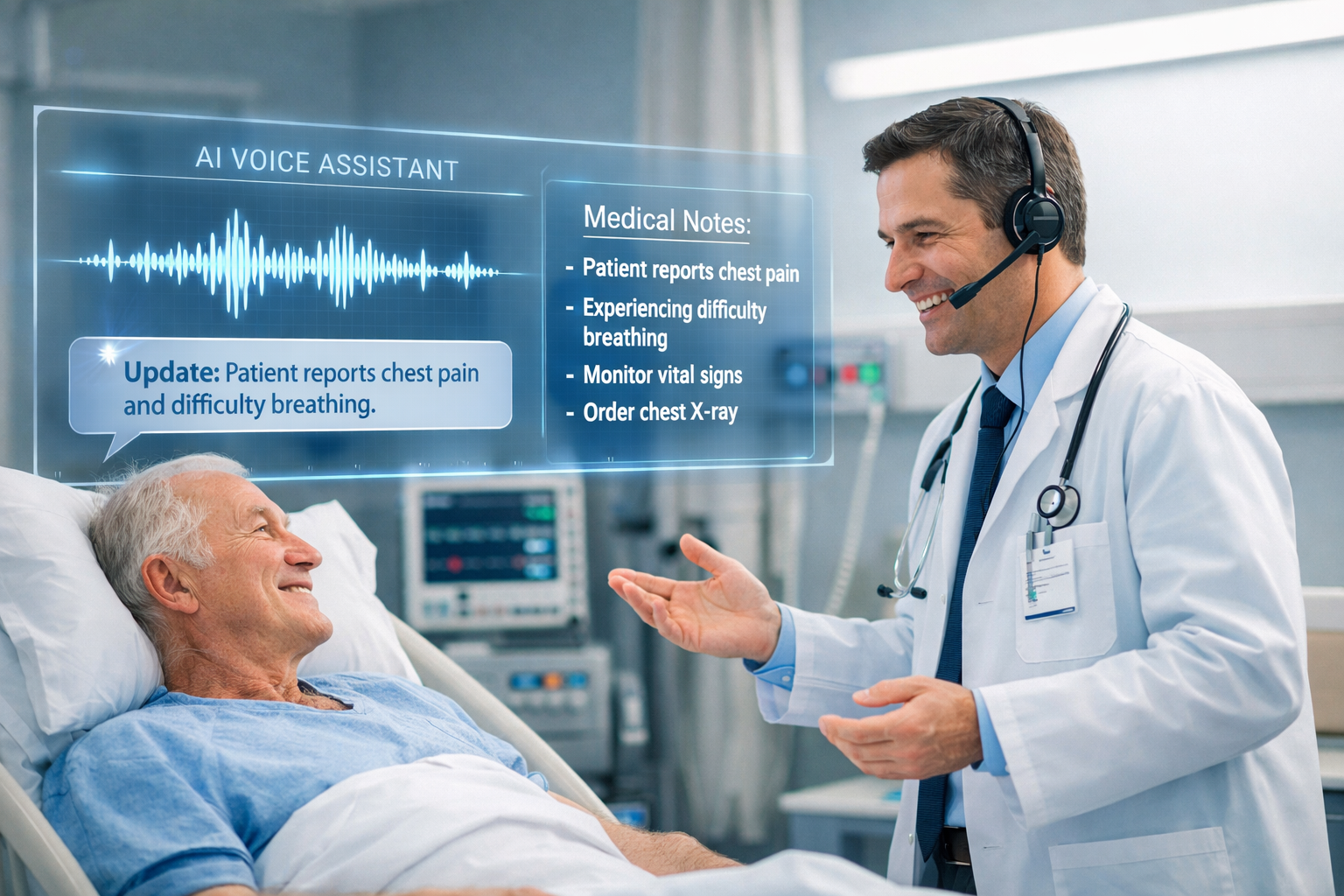
- Documentation - Voice-assisted note capture can reduce documentation time. Clinicians dictating structured notes save clicks and get home earlier.
- Voice bots can gather history and symptoms before a visit, allowing nurses to concentrate on high-value activities, therefore streamlining patient intake and triaging.
- Voice-based workflows aid to confirm drugs at entrance and discharge, therefore lowering errors.
- Voice check-ins for follow up yield better adherence than email alone in remote patient monitoring.
- Voice controls allow one to create tasks, plan follow ups, and push EHR updates.
- A basic voice triage experiment lowered no-show rates and cut phone hold times. It did not need an entire artificial intelligence team. It demanded thorough testing, a clear scope, and personnel trained to use it. That's the recurring pattern.
Choosing the right certification path for different roles
Not everyone needs the same certificate. Match training to job function and project goals.
Here are practical suggestions.
- For clinicians: Concentrate on privacy awareness, voice UX fundamentals, and clinical informatics. Clinicians should be able to identify safety concerns and examine processes.
- For healthcare IT teams, give integration skills, FHIR and API training, and cloud provider ML certification top priority. IT must deploy solutions safely and dependably.
- Get healthcare artificial intelligence training and vendor-specific certification for project managers and administrators so you can assess bids and calculate ROI.
- For artificial intelligence developers, mix hands-on voice technology instruction with clinical data governance courses and ML certificates.
- Add training on regulatory and clinical validation for medtech and device firms so your products fulfill medical device and safety requirements.
- Start with concise, useful classes. When launching pilots, micro-credentials and vendor seminars provide more immediate value than long academic courses in my view.
Common mistakes and how to avoid them
You'll see the same pitfalls over and over. Here are the big ones, and how to fix them.
- Ignoring workflow fit - The tech must match how clinicians actually work. Pilot in the real environment, not a simulated lab.
- Underestimating voice UX - Speech recognition works differently in busy wards. Test with background noise and diverse accents.
- Skipping clinical validation - A model that performs well on clean data can fail in practice. Validate with representative samples.
- Poor change management - Users must understand the tool and trust it. Train early adopters and use their feedback to improve the rollout.
- Loose security practices - Don't assume vendor claims are enough. Verify logging, data flows, and encryption settings.
One simple mistake I see often is over-optimistic accuracy numbers. Vendors will quote lab results. Ask to see real-world validation and examples of how accuracy holds up under clinical conditions.
Implementing a certification-driven rollout: a practical roadmap
When a hospital wants to adopt voice AI, I recommend a five-step approach. This keeps things small and measurable.
- Assess - Identify specific use cases and risks. Which workflows will benefit most? What data is needed?
- Pilot - Run a focused pilot on one unit or use case. Keep the scope tight and time limited.
- Validate - Use clinical validators to test safety, accuracy, and workflow fit. Involve clinicians early.
- Train and certify - Deliver role-based certification and hands-on training for staff who will use or manage the system.
- Scale and monitor - Expand to other units while monitoring KPIs and maintaining governance.
At each step, require evidence of competence. For example, before scaling, make sure the admin team holds a healthcare AI certification and the integration lead has cloud ML certs or vendor badges. That reduces surprises.
How to evaluate vendors and their certification claims
Vendors often use certificates as a shorthand for competence. That helps, but you need to dig deeper. Ask practical questions and ask for proof.
- Can you share anonymized test results on clinical data that looks like ours?
- Who on your team has clinical certifications or health informatics experience?
- How do you handle PHI? Where is data stored and how long is it retained?
- Can you show audit logs, encryption details, and incident response processes?
- Do you provide role based access and segregation of duties?
- What SLAs do you offer for uptime, throughput, and accuracy?
If a vendor refuses to show independent performance data or can't explain their security posture clearly, treat that as a red flag. Certifications are helpful, but they must map to real evidence.
Simple case examples and quick wins
Case 1. Emergency department triage.
Problem: Long triage lines and inconsistent symptom collection.
Solution: A voice AI bot collects basic history and flags red flags before triage. Nurses review the intake and prioritize high risk patients.
Result: Faster initial assessment and more consistent data in the EHR. The pilot used vendor voice training, a HIPAA and security review, and a short healthcare AI training course for the nursing leads. They saw the biggest lift in throughput during peak hours.
Case 2. Post discharge follow up.
Problem: High readmission rates due to missed medication changes.
Solution: Voice follow-up calls confirm medications and symptoms. If a red flag appears, the system escalates to a clinician.
Result: Fewer avoidable readmissions and better patient satisfaction. The project included certification for the staff running the escalation workflow and testing of the speech recognition accuracy on calls.
Both examples show a pattern. Start small, measure a single outcome, and make sure staff are trained and certified to run the system.
Certifications worth considering right now
Here are sensible certifications and training areas that help with voice AI projects in healthcare. I keep this list practical and role focused.
- Healthcare and clinical informatics - Training that covers clinical workflows, safety, and documentation.
- HIPAA and healthcare privacy - Essential for anyone handling PHI, including vendor and internal teams.
- Cloud ML certifications - AWS Certified Machine Learning, Google Cloud ML, or Azure AI certifications help developers deploy models at scale.
- Voice technology and dialog design - Courses on speech recognition performance, prompt design, and noisy environment testing.
- Security certifications - HITRUST readiness or other healthcare security training for teams responsible for compliance.
- Vendor-specific training - Certification programs from the platform you choose, especially for support and integration teams.
When selecting a certificate, ask: will this improve a real process in our hospital? If the answer is yes, it is worth the time.

Training programs and how to set up internal certification
Many hospitals benefit from a mix of external certificates and internal micro-credentials. External courses give credibility. Internal training aligns the team to your systems and policies.
Here's a quick recipe I use with clients.
- Pick 2 or 3 external short courses relevant to your roles. Make them required for project leads.
- Create a one day internal bootcamp focused on your EHR integration and workflows.
- Build a checklist-based certification. For example, an integration engineer must demo a secure EHR feed and pass a penetration test review.
- Run tabletop drills to check incident response and data leakage scenarios.
The internal certs don't need to be fancy. They need to be practical, documented, and repeatable. That way you can onboard new staff without losing institutional knowledge.
Measuring ROI and impact
Every certification program should tie back to measurable outcomes. Otherwise it looks like busy work.
Useful KPIs for voice AI projects include:
- Time saved per clinician per shift
- Reduction in documentation backlog
- Change in patient throughput or wait times
- Accuracy of speech to text for clinical concepts
- Number of escalations triggered correctly
- Readmission rates for targeted use cases
Track these KPIs during the pilot and for several months after scaling. Early on, focus on operational metrics. Later, look at clinical outcomes and cost savings.
Practical questions to ask when planning certification and vendor selection
Here are the questions I tell teams to use when they are evaluating vendors or training programs.
- What clinical problems are we solving? Is the certification directly relevant to that problem?
- How will we validate performance in our environment with our patients?
- Does the vendor provide hands-on training and documentation for our EHR?
- Who owns ongoing model monitoring and updates?
- Do we have a governance process for new prompts, dialogs, and clinical escalation logic?
- How will we measure and report adverse events or safety incidents related to the voice system?
Answering these makes it easier to pick the right certifications and to design pilots that produce clear results.
How certifications speed up adoption
Certifications help in three ways.
- They create trust - Clinicians trust teams that demonstrate competency. Certified staff inspire confidence when rolling out new tech.
- They reduce support needs - When implementers are certified, fewer issues require vendor escalation.
- They make scaling repeatable - Certified processes are easier to copy to other units and campuses.
I've seen certified operational teams go from pilot to enterprise deployment in months rather than years. Certification doesn't fix everything, but it removes friction.
Common certification pitfalls to avoid
Even with certification, projects can stall. Watch out for these traps.
- Over-certifying - Don't require expensive external certs for every role. Use targeted training instead.
- Under-specifying proof - If you accept a certificate, require a short skills demo or checklist that shows applied competence.
- Ignoring maintenance - Certifications expire and models drift. Plan for re-certification and ongoing monitoring.
- Treating certs as marketing - A vendor badge is not the same as real-world performance. Always ask for independent evidence.
Quick example: simple certification checklist for a voice pilot
Here's a short, realistic checklist you can adapt for a pilot. It focuses on practical tasks and can be completed in a few days.
- Clinician lead completes a healthcare AI awareness course.
- Integration engineer demonstrates a secure FHIR connection to a test EHR.
- Voice designer runs 50 test dialogs that include background noise and diverse accents and reports recognition accuracy.
- Security lead completes a HIPAA data flow review and documents encryption and retention.
- Project manager runs a tabletop safety drill and documents escalation paths.
If the team can check those boxes, you can move from pilot to an expanded pilot with confidence.
How agentia can help
If you're evaluating voice AI for hospitals, agentia offers hands-on experience integrating AI voice assistants in clinical settings. We focus on practical pilots and help teams implement governance, training, and integration work so you can scale safely.
We don't just sell tech. We help healthcare teams identify the right certifications, build practical internal checklists, and measure real outcomes. If you want a low-risk starting point, a short pilot with clear KPIs is a good next step.
Find more:AI in Digital Marketing: How Businesses Are Automating Growth in 2025
Final recommendations
Start small, prioritize certifications that match roles, and make sure every certificate maps to a measurable outcome. Use the certification process to create repeatable, safe deployments rather than as a box to check.
If you are leading a project right now, my suggested next steps are simple:
- Pick one clinical use case and document the expected outcome.
- Require role-based training for the pilot team and a short practical checklist for each role.
- Ask vendors for real-world validation data and proof of security practices.
- Run a pilot, measure KPIs, and use the results to plan scaling and re-certification.
Certifications are not a silver bullet, but they are one of the most practical tools you have. They make deployments safer, adoption smoother, and outcomes easier to measure.
Faqs
1. In medicine, what is artificial intelligence voice certification?
In healthcare, AI voice certification is the training courses that educate experts how to securely deploy and oversee AI voice assistants in medical settings while guaranteeing compliance and accuracy.
2. In medicine, why are artificial voice technology certifications vital?
When installing artificial voice systems, certifications aid to guarantee that teams grasp healthcare rules, patient data confidentiality, and clinical processes.
3. In healthcare, who ought to be certified in artificial voice technology?
These certifications can help hospital administrators, physicians, healthcare IT professionals, AI developers, and medtech teams working on AI voice solutions.
4. In what ways does voice artificial intelligence help healthcare processes?
Voice artificial intelligence helps healthcare personnel save time by automating clinical documentation, supporting patient intake, enabling remote monitoring, and streamlining workflows.
5. Healthcare AI voice certification include what skills?
Data privacy, voice UX design, speech recognition, artificial intelligence model validation, EHR integration, and healthcare compliance guidelines are typically included among these certifications.
Helpful Links & Next Steps
If you want to see how this works in a real clinical setting, Book a free demo today and we can walk through a tailored pilot and a certification checklist that fits your team.