Virtual Assistant AI Examples: How SMBs Use Agentia to Save 10+ Hours/Week
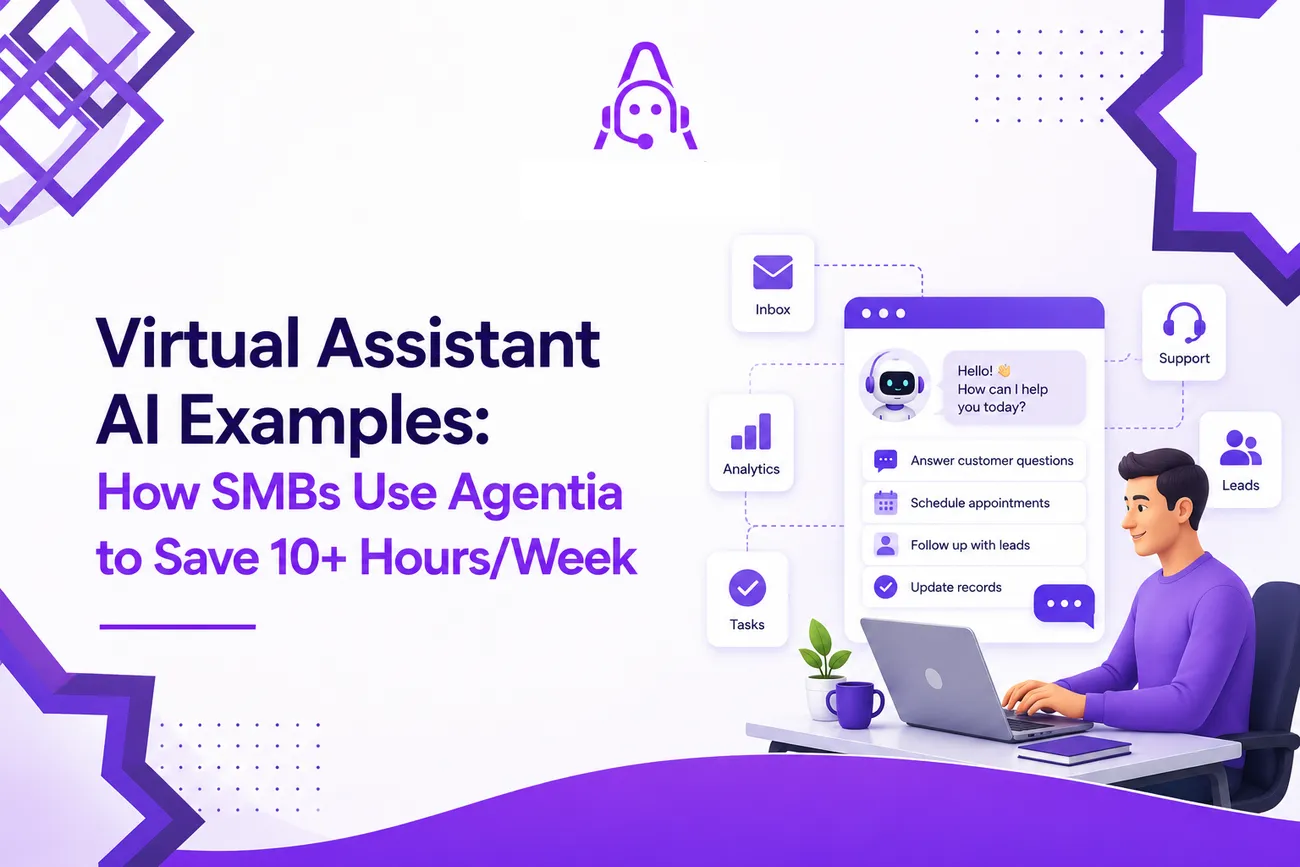
Small business owners wear a lot of hats.
On any given day, you might be answering customer emails, following up with leads, updating your CRM, managing support tickets, and trying to find time for actual growth work.
That's exactly why more businesses are investing in AI assistants.
I recently spoke with a founder who told me something that stuck with me: "I didn't need another employee. I just needed someone to handle the repetitive work that kept stealing my time."
That "someone" turned out to be an AI virtual assistant powered by Agentia.
Within a few weeks, their team had automated customer queries, organized support requests, and reduced manual work enough to save more than ten hours every single week.
And they're not alone.
Today, SMBs are using modern AI assistants to do far more than answer simple questions. These tools are becoming intelligent business partners that help teams work faster without sacrificing customer experience.
In this article, we'll explore practical virtual assistant AI examples, how small businesses are using them, and why conversational AI is quickly becoming an essential part of modern operations.
What Is an AI Virtual Assistant?
An AI virtual assistant is a software system that uses artificial intelligence to perform tasks, communicate with users, and automate routine work.
Unlike traditional automation tools, modern assistants understand context, learn from interactions, and can handle multiple steps within a workflow.
Think about all the repetitive tasks that consume time every week:
- Answering common customer questions
- Routing support tickets
- Scheduling appointments
- Following up with leads
- Updating customer records
- Searching internal documentation
These are exactly the kinds of activities that today's AI assistants can manage effectively.
The goal isn't to replace people. It's to give business owners and employees more time to focus on work that requires creativity, strategy, and human relationships.
Why SMBs Are Turning to AI Assistants
Large enterprises have invested in automation for years, but artificial intelligence is finally becoming accessible for smaller businesses.
For many SMBs, the biggest challenge isn't a lack of ideas. It's a lack of time.
Modern AI assistants help solve that problem by reducing operational bottlenecks and handling repetitive tasks that would otherwise consume valuable hours.
The benefits are easy to see:
More Time for Growth
Instead of spending hours on administrative work, teams can focus on sales, customer relationships, and business expansion.
Lower Operational Costs
Hiring additional employees isn't always practical. An artificial intelligence assistant can help businesses scale without dramatically increasing expenses.
Faster Customer Service
Customers expect quick responses. AI-powered support systems can provide immediate assistance, even outside regular business hours.
Better Team Productivity
Employees spend less time switching between tools and more time solving meaningful problems.
For growing businesses, these advantages can make a significant difference.
5 Virtual Assistant AI Examples That Save SMBs Time
Let's look at some real-world examples of how companies are using AI-driven assistants today.
1. Customer Support Automation
One of the most popular applications for an AI virtual assistant is customer support.
Instead of manually responding to every question, businesses use Agentia to:
- Answer common inquiries
- Route tickets automatically
- Retrieve information from knowledge bases
- Escalate complex cases to human agents
This approach reduces response times while allowing support teams to focus on higher-value interactions.
2. Lead Qualification and Follow-Ups
Many small businesses lose potential customers simply because they don't respond quickly enough.
Modern AI assistants can:
- Capture incoming leads
- Ask qualifying questions
- Schedule meetings
- Send personalized follow-ups
- Update CRM systems automatically
The result is a smoother sales process without additional administrative work.
3. Appointment Scheduling
Managing calendars can take more time than most people realize.
An artificial intelligence assistant can coordinate schedules, send reminders, and handle rescheduling requests without requiring constant human involvement.
For service businesses, this saves several hours every month.
4. Internal Knowledge Management
Employees often spend valuable time searching for information.
Instead of digging through documents and old emails, teams can use AI assistants to instantly retrieve:
- Company policies
- Training materials
- Product information
- Customer histories
- Support documentation
This improves productivity across the organization.
5. Customer Communication
A modern conversational AI assistant can handle customer interactions across multiple channels.
Whether customers reach out through chat, email, or messaging apps, the assistant maintains context and provides consistent experiences.
This creates smoother communication without overwhelming small teams.
How Conversational AI Assistants Are Changing Customer Support
Traditional chatbots often frustrated customers.
They followed rigid scripts, lacked context, and struggled with anything outside predefined rules.
A conversational AI assistant works differently.
Instead of simply matching keywords, it understands intent and responds more naturally.
For example, if a customer asks about a delayed order, the system can:
- Identify the issue
- Access order information
- Explain the situation
- Offer next steps
- Escalate the case if necessary
This creates a much better customer experience.
Businesses using a conversational AI assistant are seeing improvements in:
- Customer satisfaction
- Response times
- Agent productivity
- Operational efficiency
The technology isn't replacing human interactions. It's making those interactions more meaningful by removing repetitive work.
How Agentia Helps SMBs Save 10+ Hours Every Week
At Agentia, we focus on helping businesses build practical AI solutions that fit naturally into existing workflows.
The objective isn't automation for its own sake.
It's about giving teams their time back.
Here's how Agentia works as an AI virtual assistant for SMBs.
Understanding Customer Intent
Agentia analyzes incoming messages to determine:
- Customer needs
- Sentiment
- Urgency
- Appropriate actions
This allows businesses to provide faster and more accurate responses.
Automating Routine Tasks
The platform helps teams automate common activities such as:
- Ticket categorization
- Password resets
- FAQ responses
- Customer updates
- Workflow triggers
These repetitive processes often consume hours every week.
Keeping Humans in the Loop
Not every conversation should be automated.
When issues become sensitive or complex, Agentia seamlessly transfers interactions to human team members.
The combination of people and intelligent technology creates the best possible outcomes.
Working Across Existing Tools
Businesses don't want another disconnected platform.
Agentia integrates with:
- CRM systems
- Knowledge bases
- Helpdesk software
- Communication channels
This allows your artificial intelligence assistant to work within the systems your team already uses.
Why the Future Belongs to AI Assistants
The demand for smarter automation continues to grow.
Businesses are no longer asking whether they should use AI.
They're asking how quickly they can implement it effectively.
Modern AI assistants offer a practical way to improve efficiency without sacrificing customer relationships.
For SMBs, this creates opportunities that were once available only to larger organizations.
A small team with the right technology can now deliver experiences that rival much bigger competitors.
The businesses that embrace these tools today will be better prepared for the future of customer service, operations, and growth.
Getting Started With an AI Virtual Assistant
If you're considering adopting an AI virtual assistant, start small.
Begin with repetitive tasks that consume the most time.
Examples include:
- Customer support inquiries
- Appointment scheduling
- Lead qualification
- Knowledge retrieval
- Internal workflows
Measure the results, gather feedback, and expand gradually.
The goal is sustainable improvement, not overnight transformation.
When implemented thoughtfully, even simple automation can save ten or more hours every week.
That's time your team can invest in customers, products, and business growth.
Conclusion
Small businesses succeed when their people spend time on work that truly matters.
Modern AI assistants help make that possible.
Whether it's through customer support automation, smarter communication, or workflow management, these tools are becoming valuable partners for growing companies.
Agentia demonstrates how a powerful conversational AI assistant can reduce repetitive work while keeping human relationships at the center of every customer experience.
The future isn't about replacing people.
It's about helping people do their best work.
FAQs
What is an AI virtual assistant?
An AI virtual assistant is an intelligent software system that automates tasks, communicates with users, and helps businesses improve productivity through artificial intelligence.
How do AI assistants help small businesses?
AI assistants help SMBs by automating customer support, managing schedules, qualifying leads, retrieving information, and reducing repetitive administrative work.
What is a conversational AI assistant?
A conversational AI assistant uses natural language processing to understand customer intent and provide human-like interactions across chat, email, and other communication channels.
Can an artificial intelligence assistant replace employees?
No. An artificial intelligence assistant is designed to support employees by handling repetitive tasks, allowing people to focus on strategic, creative, and relationship-driven work.
How does Agentia help businesses save time?
Agentia automates customer support workflows, knowledge retrieval, ticket management, and routine processes, helping SMBs save more than ten hours each week while improving customer experiences.